
XKubernetes is a portable, extensible, open source platform for managing containerized workloads and services, that facilitates both declarative configuration and automation. It has a large, rapidly growing ecosystem. Kubernetes services, support, and tools are widely available.
Why you need Kubernetes and what it can do
Containers are a good way to bundle and run your applications. In a production environment, you need to manage the containers that run the applications and ensure that there is no downtime. For example, if a container goes down, another container needs to start. Wouldn’t it be easier if this behavior was handled by a system?
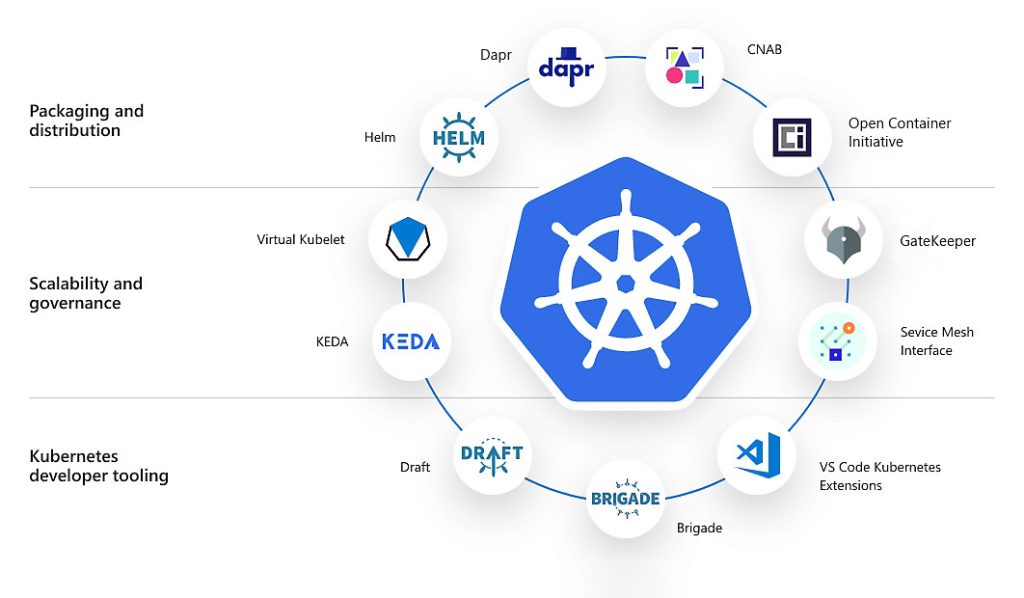
That’s how Kubernetes comes to the rescue! Kubernetes provides you with a framework to run distributed systems resiliently. It takes care of scaling and failover for your application, provides deployment patterns, and more. For example, Kubernetes can easily manage a canary deployment for your system.
Kubernetes provides you with:
- Service discovery and load balancing Kubernetes can expose a container using the DNS name or using their own IP address. If traffic to a container is high, Kubernetes is able to load balance and distribute the network traffic so that the deployment is stable.
- Storage orchestration Kubernetes allows you to automatically mount a storage system of your choice, such as local storages, public cloud providers, and more.
- Automated rollouts and rollbacks You can describe the desired state for your deployed containers using Kubernetes, and it can change the actual state to the desired state at a controlled rate. For example, you can automate Kubernetes to create new containers for your deployment, remove existing containers and adopt all their resources to the new container.
- Automatic bin packing You provide Kubernetes with a cluster of nodes that it can use to run containerized tasks. You tell Kubernetes how much CPU and memory (RAM) each container needs. Kubernetes can fit containers onto your nodes to make the best use of your resources.
- Self-healing Kubernetes restarts containers that fail, replaces containers, kills containers that don’t respond to your user-defined health check, and doesn’t advertise them to clients until they are ready to serve.
- Secret and configuration management Kubernetes lets you store and manage sensitive information, such as passwords, OAuth tokens, and SSH keys. You can deploy and update secrets and application configuration without rebuilding your container images, and without exposing secrets in your stack configuration.
Kubernetes Components
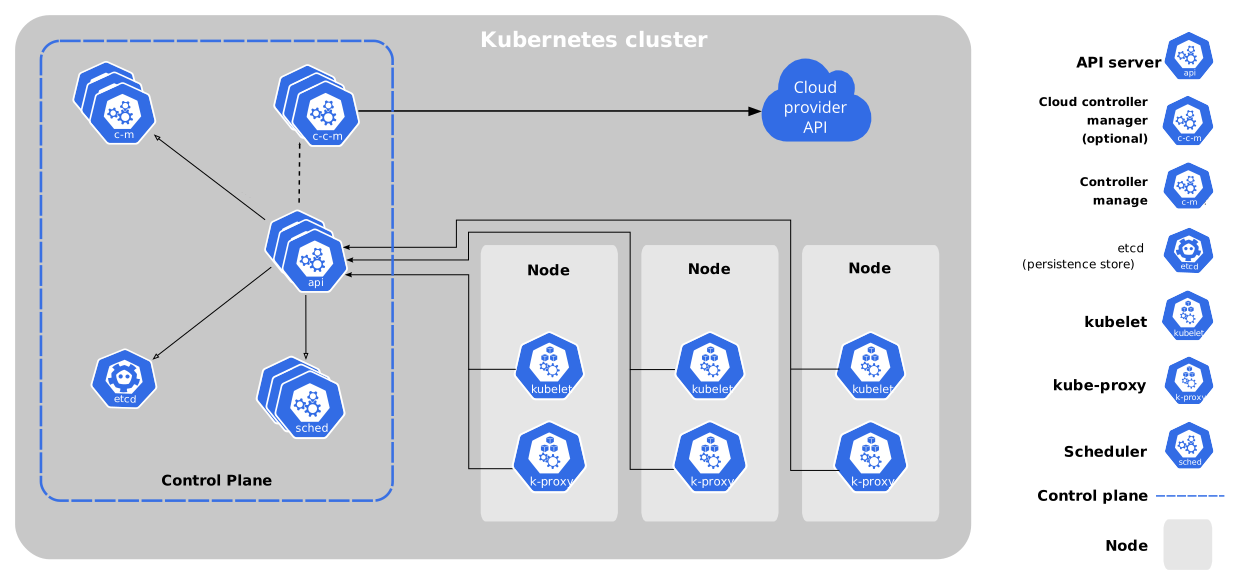
When you deploy Kubernetes, you get a cluster.
A Kubernetes cluster consists of a set of worker machines, called nodes, that run containerized applications. Every cluster has at least one worker node.
The worker node(s) host the pods that are the components of the application workload. The control plane manages the worker nodes and the Pods in the cluster. In production environments, the control plane usually runs across multiple computers and a cluster usually runs multiple nodes, providing fault-tolerance and high availability.
This document outlines the various components you need to have for a complete and working Kubernetes cluster.
Advantages of Kubernetes:
Scalability: Kubernetes allows developers to easily scale their applications up or down as demand fluctuates. The platform automatically monitors the health of each component of the application and can dynamically adjust the number of instances running based on the demand. One of the biggest advantages of Kubernetes is its ability to scale applications horizontally. Kubernetes can automatically scale the number of application instances based on the demand, making it an ideal platform for handling sudden spikes in traffic. This makes it easy to ensure that the application remains available and responsive to users.
Resource efficiency: Kubernetes helps optimize the use of resources by scheduling containers to run on the most appropriate node based on their resource requirements. This ensures that resources are used efficiently, reducing the cost of running the application. Kubernetes can help organizations optimize resource utilization by intelligently scheduling and managing containers across nodes. This ensures that resources are used efficiently and reduces infrastructure costs.
High availability: Kubernetes provides mechanisms for ensuring that applications are always available. For example, it can automatically restart containers that fail, and it can schedule replicas of containers across different nodes to ensure that the application can survive node failures. Kubernetes provides built-in features for ensuring high availability of applications. It automatically restarts failed containers, moves them to other nodes, and schedules them to run on healthy nodes. This ensures that the application is always available to users, even in the event of hardware failures.
Portability: Kubernetes provides a consistent deployment platform across different environments, whether it is on-premises or in the cloud. This makes it easier for developers to deploy their applications in a variety of environments without having to modify their code. Kubernetes is designed to be cloud-agnostic, which means that it can run on any cloud provider or on-premises infrastructure. This allows organizations to avoid vendor lock-in and choose the platform that best meets their needs
Self-healing: Kubernetes can detect and respond to failures in the application by automatically restarting containers, rolling back deployments, and rescheduling workloads. Kubernetes is designed to be self-healing. If a container crashes or becomes unresponsive, Kubernetes automatically detects the failure and restarts the container. This ensures that the application remains available and minimizes downtime.
Service discovery and load balancing: Kubernetes provides a built-in service discovery and load balancing mechanism, which allows developers to easily expose their application services and manage traffic between them.
Extensibility: Kubernetes is highly extensible, allowing developers to integrate it with other tools and services. This makes it easy to add new features and functionality to the deployment pipeline
Open-source: Kubernetes is open-source, meaning that it is free to use and has a large community of developers contributing to its development. This results in a platform that is constantly evolving and improving.
Fault tolerance: Kubernetes provides robust fault tolerance features, such as automatic failover and self-healing. It can detect when a container is unhealthy and automatically replace it with a new one. This ensures that the application remains operational and minimizes downtime.
Portability: Kubernetes is designed to be cloud-agnostic, which means that it can run on any cloud provider or on-premises infrastructure. This allows organizations to avoid vendor lock-in and choose the platform that best meets their needs.
Flexibility: Kubernetes provides a high degree of flexibility in how applications are deployed and managed. It allows organizations to define their own deployment strategies, such as rolling updates, blue-green deployments, and canary releases. This enables teams to iterate quickly and deploy new features with minimal disruption to the end-users.
Disadvantages of Kubernetes:
Complexity: Kubernetes can be complex to set up and manage, particularly for small teams or organizations with limited resources. It requires a significant amount of configuration and expertise to properly set up and maintain. Kubernetes is a complex platform, and it can be challenging to set up and manage. It requires a high level of expertise in containerization, networking, and distributed systems. This can make it difficult for organizations to get started with Kubernetes and maintain it over time.
Learning curve: Developers and operations teams need to learn how to use Kubernetes effectively. This can take time and effort, particularly for those who are new to containerization and orchestration. Kubernetes has a steep learning curve, especially for developers who are new to containerization and distributed systems. It requires a deepunderstanding of Kubernetes concepts, such as pods, nodes, services, and controllers. This can slow down development and deployment processes.
Performance overhead: Kubernetes introduces some overhead in terms of CPU and memory usage, which can impact application performance. While this is usually negligible, it can become a concern in large-scale deployments. Kubernetes introduces additional overhead, such as networking, load balancing, and service discovery. This can add latency to the application and reduce performance.
Security: Kubernetes has a complex security model, and it is important to properly configure and secure the platform to ensure that applications are protected against potential security threats. Kubernetes introduces additional security considerations, such as securing the Kubernetes API server and ensuring that containers are running with the appropriate permissions. This requires a high level of expertise in Kubernetes security best practices.
Dependency on external services: Kubernetes relies on external services such as container registries, network storage providers, and load balancers. This introduces dependencies that need to be managed and can impact the overall reliability of the application.
Incompatibility with some legacy applications: Kubernetes may not be compatible with some legacy applications that are not designed to run in a containerized environment. This can make it difficult to migrate some applications to Kubernetes.
Infrastructure requirements: Kubernetes requires a robust and reliable infrastructure to run on. This includes a suitable number of nodes with sufficient resources, reliable networking, and a persistent storage layer. Kubernetes requires significant resources, such as memory, CPU, and storage. It can be expensive to run on low-end hardware, and it requires a large amount of infrastructure to run at scale.
Lack of maturity: Kubernetes is a relatively new technology, and it is still evolving rapidly. This can make it difficult for organizations to keep up with the latest features and best practices. Additionally, Kubernetes can be prone to bugs and performance issues, especially with complex deployments.
Complexity of networking: Kubernetes provides a highly flexible and configurable networking model, but this can also make networking more complex. Setting up networking in Kubernetes requires a deep understanding of networking concepts, such as service meshes, load balancers, and network policies.
Conclusion:
Kubernetes is an excellent containerized application management solution that provides scalability, high availability, and automation. Although it comes with some complexity and a steep learning curve, the benefits generally outweigh the cons for organizations that want to develop resilient and effective systems. With the adoption of Kubernetes, businesses will be able to modernize their infrastructures, ease the deployment processes, and achieve uniform performance standards across varied environments. This will also free up teams to concentrate more on innovation rather than infrastructure management.