
Author: kishan

  • Custom Scheduler vs n8n: Which One Should You Choose for Automation?

    Custom Scheduler vs n8n: Which One Should You Choose for Automation?

    Businesses need schedulers to:

    • Automate routine processes and reduce human intervention.
    • Improve task execution efficiency and consistency.
    • Ensure tasks run on time, whether at fixed intervals or based on events.
    • Integrate with other applications for seamless workflow automation.

    When considering a scheduler, companies often choose between building a custom scheduler tailored to their needs or using an off-the-shelf solution like n8n, an open-source workflow automation tool. In this blog, we will compare these two approaches and help you decide which one is best for your use case.

    What is a Custom Scheduler?

    A custom scheduler is an in-house solution designed to execute jobs at specific intervals based on unique business requirements. Unlike pre-built schedulers such as n8n, which provide a visual, workflow-based automation tool, a custom scheduler offers full control over execution logic, optimization, security, and scalability. While it requires more development effort, it ensures precise alignment with business workflows and infrastructure.

    Common Technologies Used:

    • Python: Celery, APScheduler, Schedule
    • Node.js: Agenda.js, BullMQ
    • Linux: Cron Jobs

    Key Characteristics:

    • Tailored Execution: Built for specific business needs. Tailored execution logic for complex workflows.
    • Complete Control: Full control over job scheduling, resource allocation, and optimizations.
    • Integration Flexibility: Can be designed to work with any system.
    • Reliability & Error Handling: Robust error handling and failover mechanisms.
    • Requires Maintenance: Ongoing support for scaling, monitoring, and debugging.
    • Development Effort: Needs a dedicated development team.

    What is n8n?

    n8n is an open-source workflow automation tool that provides an intuitive, drag-and-drop interface for building automated workflows, including scheduling tasks without extensive coding.

    Key Features:

    • Visual Workflow Builder: No-code, easy-to-use UI for workflow creation.
    • Pre-Built Integrations: Supports 400+ integration tools, e.g., Google Sheets, Slack, email, APIs, and more.
    • Self-Hosting & Cloud Deployment: Offers flexibility in deployment options.
    • Scalability & Monitoring: In-built logging and error handling.
    • Less Customization: Limited flexibility compared to fully custom solutions.
    • Dependency on Third-Party Support: Requires updates from the n8n community or paid enterprise support.

    Feature Comparison: Custom Scheduler vs. n8n

    FeatureCustom Schedulern8n
    Development EffortHigh (requires coding)Low (drag-and-drop)
    FlexibilityVery HighModerate
    MaintenanceRequires ongoing supportManaged by n8n/cloud
    IntegrationsCustom-built integrationsPre-built integrations
    ScalabilityHigh (depends on infra)Scalable but limited
    Security ControlComplete controlLimited to n8n settings
    MonitoringRequires custom setupBuilt-in logging & alerts
    SimplicityScripting based Visual workflow automation
    Best forDevelopers, custom logicBusiness users, quick automation

    Best Use Cases for Each

    Use a custom scheduler if:

    • You have highly specific, complex scheduling needs.
    • You need full control over execution, optimization, and security.
    • You have a dedicated development team to maintain it.
    • You require deep integration with your existing infrastructure.

    Use n8n if:

    • Enrich leads automatically—Connect form builders such as Jotform, Typeform, or HubSpot with contact verification services.
    • Limitless CRM integration— Transfer your leads to any tool like Pipedrive, Salesforce, or HubSpot.
    • Set up automated actions—trigger specific actions when events occur (e.g., lead status changes, customer purchases).
    • Minimize risk, maximize protection—eliminate IT errors to ensure infrastructure stability and reliability.
    • Custom data integration—Integrate with any API or database to pull data from legacy or niche systems.
    • Automated data enrichment—Fetch additional information via APIs and databases to enhance CRM data.
    • Advanced lead scoring and routing—Integrate with machine learning models for intelligent lead scoring and routing.
    • Custom notifications and alerts—Set up custom alerts across channels (email, SMS, Slack) triggered by specific conditions.
    • Automated personalization with AI—Use AI to segment customers and automate personalized marketing communications.

    Conclusion: Which One Is Right for You?

    Choosing between a custom scheduler and n8n depends on your business needs and resources.

    • If you require full control and deep customization and have the resources to build and maintain a scheduler, a custom solution is the best choice.
    • If you want quick automation, pre-built integrations, and a low-code approach, n8n is a great option.

    For businesses looking to scale rapidly with minimal development effort, n8n is the way to go. However, if you need a highly customized and optimized scheduling system, investing in a custom scheduler will pay off in the long run.

    Final Thought: If your priority is speed and ease of setup, choose n8n. If you need custom logic, security, and scalability, go with a custom scheduler.
  • Agile: Understanding The Core Principles of Agile Methodology

    Agile: Understanding The Core Principles of Agile Methodology

    The term “Agile” is widespread in the domain of project management, but what does it mean? This goes more beyond a single term. It signals a holistic change in a project approach towards more collaboration, improvement, and flexibility as the central characteristics. In this blog post, we explore the Agile core processes for its structures, pillars and methodologies to give complete insights into its world.

    What is AGILE?

    Agile Methodology is an iterative and incremental approach to project management and software development with an emphasis on getting value out to customers quickly, incorporating feedback quickly as well as changing as needed. Agile is adaptive to changes as they come with no rigid structures and sequences. These approaches are critical in modern-day fast changing environments where there are near constant changes and competition.

    Core Principles of Agile

    Four primary values and twelve principles core to the methodology are stated in the Agile manifesto. Among them, the following are the most salient. Agile teams are guided by these principles towards the decisions that they make and the actions they take.

    1. Customer Focus: Agile places great emphasis in understanding customer needs while creating a product and making sure feedback is received during the project so that the ultimate end goal can be met.
    2. Embrace Change: With Agile, requirements and policies can change at any time and being adaptable to these changes is particularly useful in this age of fast moving business environments.
    3. Fast and Frequent Delivery: The Agile Methodology breaks down the process of development into components and instead of planning for a full-fledged system, they prefer iteratively building working software through cycles called sprints. This enables for much-needed feedback very early in the process while also lowering the chances of constructing something unwanted.
    4. Collaboration: The development team, customers, and stakeholders are always on the same page and in close collaboration that allows them to jointly achieve the desired goals and objectives. Complete communication and understanding serve as foundational principles.
    5. Continuous Improvement: It facilitates self improvement across teams and processes. Teams have the ability and permission to identify issues, reflect, and change processes accordingly. When done properly, this always leads to improvement in both quality and productivity.
    6. Team Respect: Agile provides team members with trust and power as it values self-organization. This delegation of responsibility helps create a friendly and efficient atmosphere.

    Agile Process:

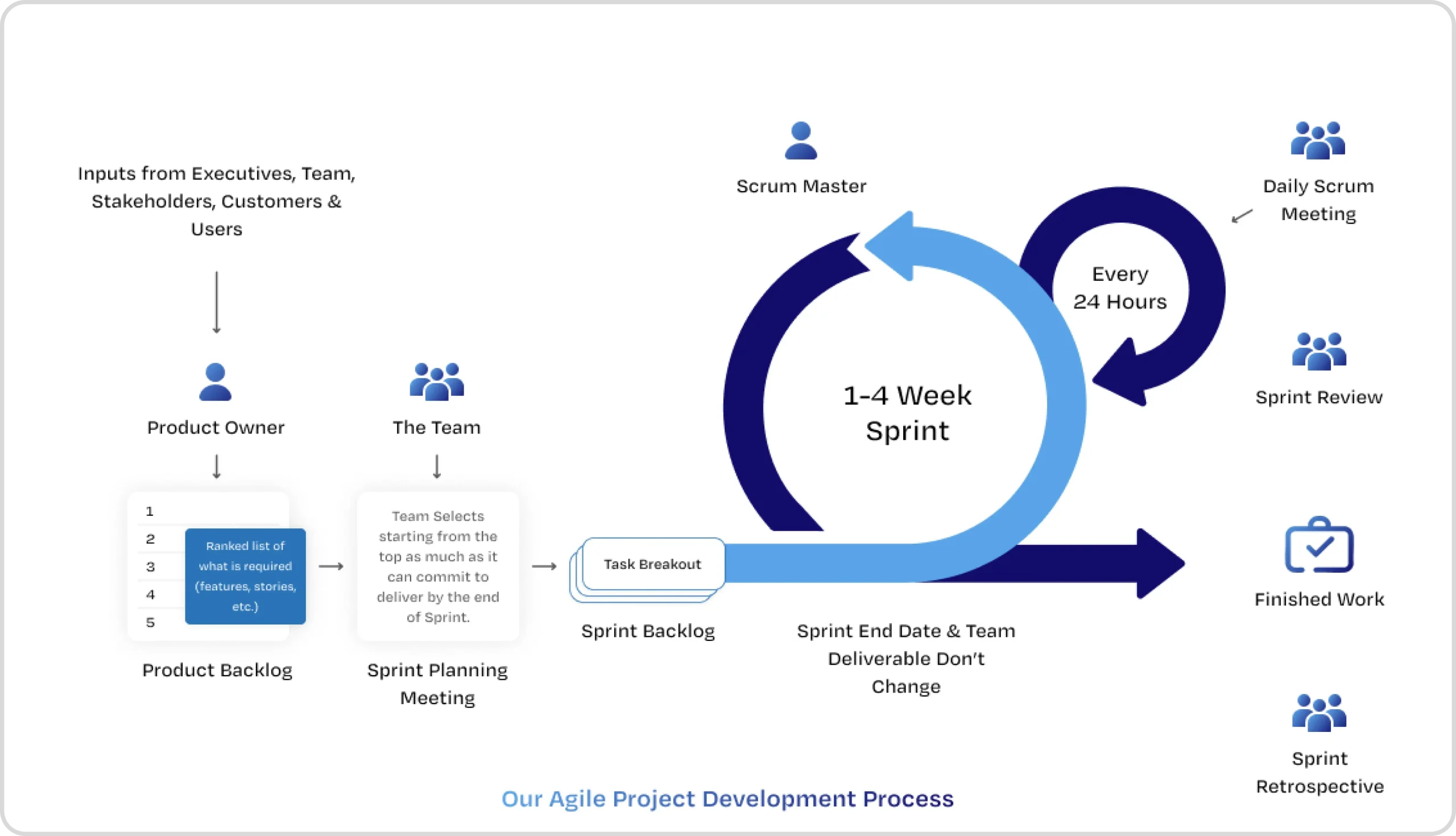
    A general Agile framework is very simple and encompasses planning, sprints/iterations, testing, and maintenance, while specific frameworks like Scrum and Kanban have their own particular processes:

    1. Planning: Set the broad goals and create a product roadmap which essentially is a living document that is updated constantly as new tasks are identified. All the features that need to be implemented are sorted by priority in the product backlog.
    2. Sprints/Iterations: Work on the identified tasks in short cycles (e.g., 2 weeks) to work on specific features of the product that are defined in the project backlog. By the end of the two weeks, the goal of the sprint should be met and a working version of the software increment should be put out.
    3. Daily stand-ups: Short daily meetings for the team to align efforts, know of any issues, and devise a plan for the day. These meetings are aimed at encouraging engagement and openness.
    4. Review: At the end of each sprint, the team displays its working demo to the client and collects their feedback which is then used to improve the product backlog and decide the next sprint’s plan.
    5. Retrospective: During this phase, the team analyzes the sprint and finds out how they did in terms of the process and their interactions. This approach is what makes Agile work, a cycle of continuous improvement.

    Key Pillars of Agile

    Three key pillars support the Agile principles and process:

    1. Transparency: No single person has control over the project, and a shared responsibility for the success or failure of a project results in open communication and visibility into the progress of the project.
    2. Inspection: Regular inspection of the work being done and its processes in order to discover problems and solve them proactively. This can be applied to the product increment, the activities of the team, and the project’s progress.
    3. Adaptation: Response to feedback ideas is also one of the principles of Agile. Changes have to be made after inspection of the feedback concerning the product, the team and project processes, and the project as a whole.

    What has led to the popularity of agile?

    Agile is popular today because it solves modern project management problems. Customer centricity, flexibility and improvement enables Agile to effectively manage complicated projects in an ever changing world. Agile allows managing complex projects in a complex world. Teams are able to deliver value in record time, eliminate unnecessary steps, and in the end, produce better goods. Agile allows teams to embrace change, foster collaboration, and mitigates uncertainty to ensure positive outcomes. Agile surely makes projects a lot more efficient.

    Your vision, our skills. Let’s build your dream product together. Ellocent Labs – Agile development you can trust. Reach Us Today!